
What to Do When Your AC Stops Working in Lake Charles
Work through these safe steps in the first hour after the AC quits, then call us and we can send a Lake Charles technician.
Start with the safety checks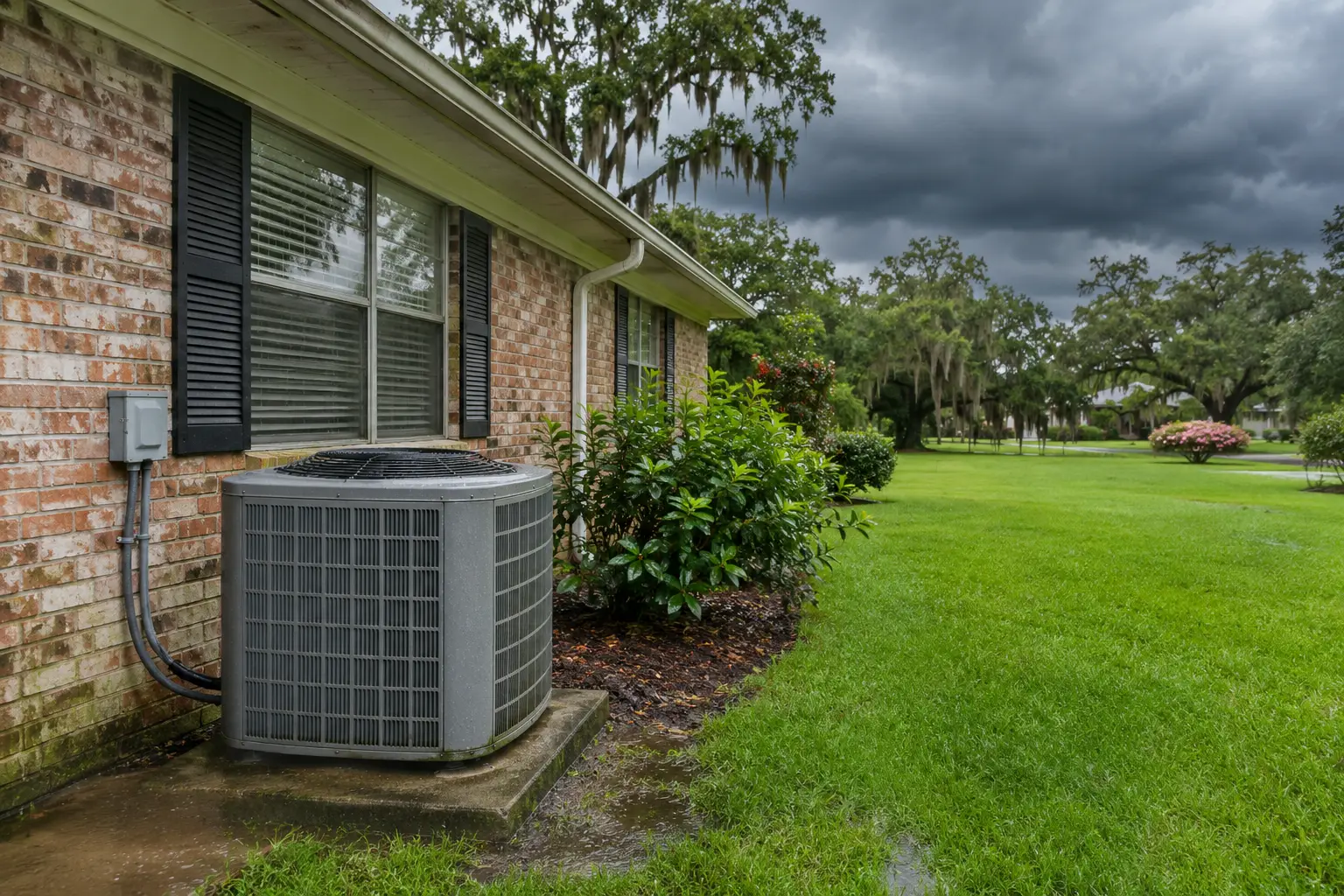
Safety comes before any reset
When your AC stops working in Lake Charles heat, the first instinct is to get it running again. Take thirty seconds to make sure that is safe.
Any warning sign in the box beside this text means switching the system off at both the thermostat and the breaker immediately. Then keep everyone away from the outdoor unit and the indoor unit until a technician looks at it.
Water and electricity are the biggest risks in our climate. A drain pan that overflowed onto wiring or a unit that sat in flood water can be dangerous to restart, even if it looks fine once it dries.
Never open the panels on either unit. The outdoor unit carries 240 volts, and its capacitor can hold a charge after the power is off.
Shut it off now if you notice
- A burning plastic or electrical smell.
- Smoke or sparks at either unit.
- A loud buzz or grinding from the outdoor unit.
- Water near wiring, the thermostat or the indoor unit's power.
- Flood water that reached the outdoor unit.
What to do in the first fifteen minutes when your AC stops working
If nothing looks unsafe, work through these in order. Each one takes a minute or two, and together they solve a fair share of no cooling calls.
Thermostat
Look for cool mode, an auto fan and a target lower than the room reading. Replace the batteries if the screen is dim or blank.
Breakers
Look for a tripped AC breaker in the main panel and check the disconnect box beside the outdoor unit. Reset any tripped breaker a single time.
Filter
A filter that blocks light may be icing the coil. Swap in a new one that matches the size on the frame.
Outdoor unit
With cooling on, the top fan should spin and you should hear the compressor. Note whether it is silent, humming or running.
Indoor unit
Look for water around it and ice on the copper lines. A full pan can trip a float switch that shuts everything down.
Wait and retry
After a reset, give the system five minutes. Many outdoor units wait a few minutes before restarting to protect the compressor.
Match the symptom to the most likely cause
Once you have done the checks, match what you see to a row below. The last column opens the page for that repair, with the causes and what a technician does about them. If your AC stops working in a way that fits more than one row, mention every sign when you call.
| What you see | Common causes | Repair page |
|---|---|---|
| Nothing runs, inside or out | Thermostat off or blank, a tripped breaker, a float switch or a blown fuse | Thermostat repair |
| Indoor fan runs, outdoor unit is silent | Failed contactor or capacitor, or the outdoor breaker is off | Capacitor and contactor repair |
| Outdoor unit hums, fan does not spin | Weak capacitor or a seized fan motor | Capacitor and contactor repair |
| Everything runs, air is warm | Dirty coil, low refrigerant or a compressor problem | AC not cooling repair |
| Ice on the copper line | Poor airflow or a low charge | Frozen AC coil repair |
| Water around the indoor unit | Clogged drain and a full pan | AC leaking water repair |
If the AC runs but the house will not cool and none of these rows fit, our guide on an AC running but not cooling goes through the causes in more depth.
How to keep the house cooler while you wait
A house in Lake Charles can warm up fast on a summer afternoon, often a few degrees an hour once the AC stops. These steps slow it down and keep everyone safer until the repair.
Block the sun
Close blinds and curtains, starting with windows that face west and south. Sunlight through glass heats a room quickly.
Move the air
Run ceiling fans counterclockwise and use box fans. Moving air makes your skin feel cooler, even when the room is not.
Pick one room
Choose the coolest room, often on the lowest floor and away from the afternoon sun, and keep its door closed.
Skip heat makers
Avoid the oven, the stove, the dryer and the dishwasher dry cycle until the AC is running again.
Drink water
Keep water nearby for everyone, and give pets cool water and a shaded spot on a hard floor.
Open up at night
If the evening air is cooler and dry enough, open windows on opposite sides of the house to pull it through.
Watch for heat illness
Heavy sweating, dizziness, headache, nausea and weakness are signs of heat exhaustion. Move the person somewhere cool, loosen clothing and give sips of water. Confusion, fainting or hot, dry skin can mean heat stroke, which is an emergency. Call 911.
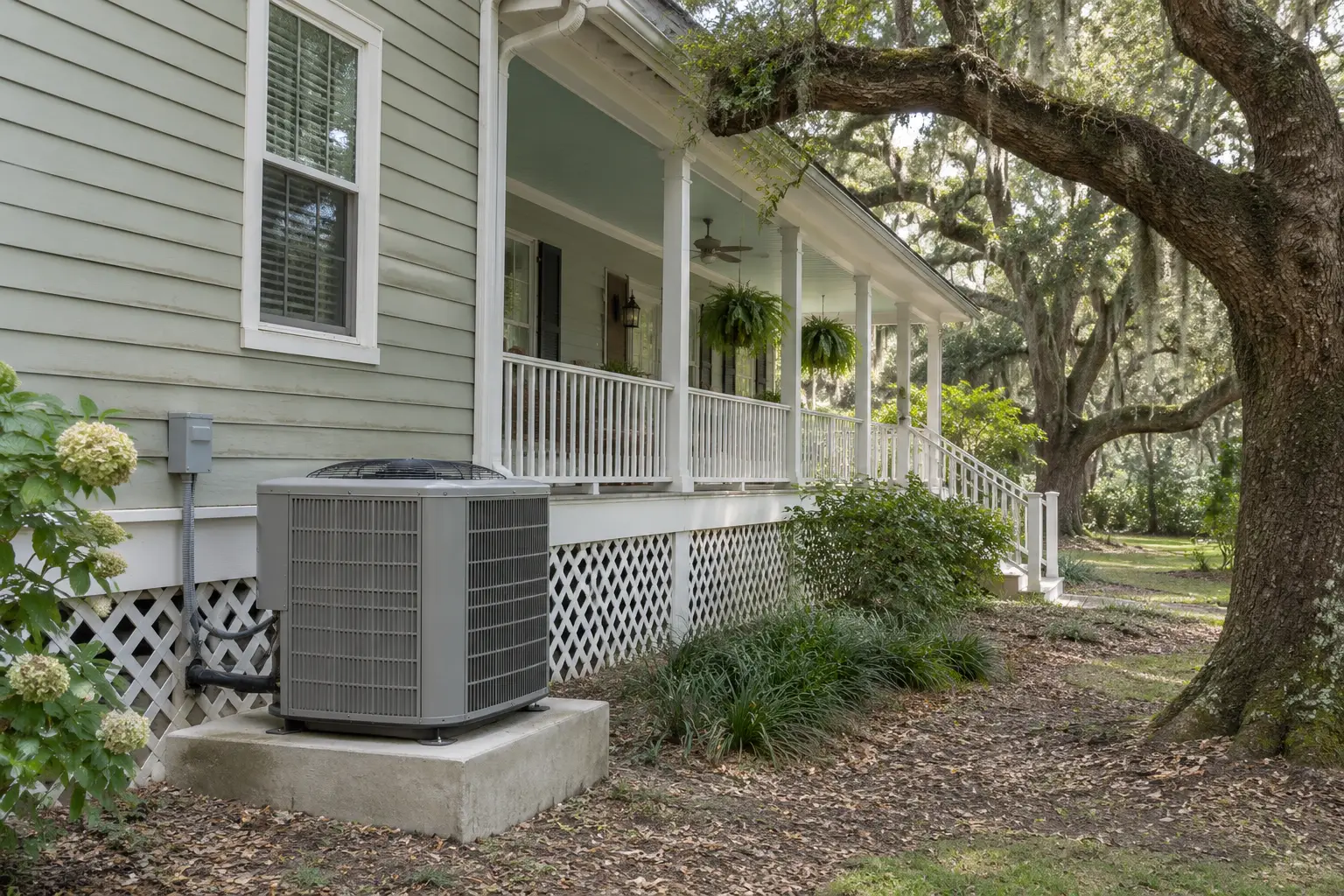
When the AC stops after a storm or an outage
Storms are a regular part of life here, and they are hard on air conditioners. Before you turn the AC back on after a storm, walk around the outdoor unit.
- Leave it off if water reached the unit or its electrical box.
- Clear branches and debris from the top and sides.
- Look for bent fins or a unit knocked off its pad.
- Give the power a few minutes to settle before you restart it.
If it will not start after that, call. Surges often damage the capacitor or the control board. During hurricane season, it also helps to know where your AC breaker and outdoor disconnect are before a storm arrives, so you can switch them off if flooding is likely.
Details to have ready for the call
The more the technician knows in advance, the better prepared the visit is. Part names are not required.
When your AC stops working in Lake Charles during a heat wave, many homes call at once, so the details below help the visit go smoothly.
What the AC was doing when it stopped
Did it stop suddenly, fade over days or start making a new noise first? Did the lights flicker or a storm pass through? The timeline often points straight at the cause.
What each unit is doing now
Tell us whether the indoor fan runs, whether the outdoor fan spins and whether you hear humming, clicking or nothing at all. Mention any ice, water or smell.
What you already tried
Say whether you changed the filter, reset a breaker or replaced the thermostat batteries, and what happened after each step.
Where the units are
Note whether the indoor unit is in the attic, a closet or the garage, and whether the outdoor unit sits on a platform. Mention gates, dogs or anything that affects access.
The age and type of the system
If you know roughly how old the system is, or whether it is a heat pump or a standard AC, mention it. The label on the outdoor unit usually shows the brand and the type of refrigerant, which helps the technician bring the right parts.
Who is in the house
If a baby, an older adult or someone with a health condition is at home, say so. It helps when the visit is planned.
Mistakes that make a stopped AC worse
Each of these feels reasonable in a sweltering house, yet any of them can make a modest repair much larger.
The safest plan is simple. Do the checks above once, keep the house as cool as you can and let a technician take it from there.
Resetting the breaker again and again
Each reset sends power into a fault and can damage the compressor or the wiring.
Setting the thermostat to 60
A system with a fault does not cool faster at a low setting, and a weak coil may freeze.
Running a frozen system
Ice blocks airflow and can send liquid refrigerant to the compressor. Thaw it with the fan only.
Spraying a running unit with a hose
Water on live electrical parts is a shock risk and will not restart a failed part.
Buying refrigerant online
Home recharge cans do not fix a leak, and the wrong product can damage the system.
Pushing the fan with a stick
It puts your hands near moving blades and high voltage, and running on a weak capacitor overheats the motor.
Questions people ask when the AC stops working
-
My AC just quit. Where do I start?
Check that nothing is unsafe. Burning odors, smoke or harsh buzzing mean shutting it down at the thermostat and the breaker. If everything seems safe, look at the thermostat settings, the breaker and the filter, in that order.
-
How many times can I reset the AC breaker?
Once. A breaker that trips again right away is protecting the wiring from a real fault, such as a shorted motor, a failed capacitor or a compressor that cannot start. Keep it off and call so the fault can be traced.
-
Is there a reset button on my air conditioner?
Some indoor units and some outdoor units have one, but many do not. Do not open panels looking for it. Turning the system off at the thermostat for five minutes and back on is a safe reset for most systems.
-
Why did my AC stop working right after a power outage?
Some thermostats reset to off or to a default program after an outage, and a surge when power returns can damage a capacitor or a control board. Many outdoor units also wait a few minutes before restarting to protect the compressor.
-
My AC stopped and the thermostat screen is blank. Why?
Try new batteries first. If it stays blank, a float switch may have cut power because the drain pan is full of water, or a fuse in the indoor unit may have blown. Look for water around the indoor unit and read about AC leaking water repair.
-
How hot can it get inside before it is dangerous?
There is no single number, but indoor heat in the upper 80s and above is risky for babies, older adults, pets and people with heart, lung or kidney problems. If someone shows signs of heat illness, move them somewhere cool and call 911 for confusion, fainting or a very high body temperature.
-
Should I hose down my outdoor unit if the AC stops?
Not as a fix. Spraying a running unit does not repair a failed part and can soak electrical parts. A gentle rinse of a dirty coil with the power off is fine as routine upkeep, but it will not restart an AC that has stopped working.
-
Can I run fans and leave the AC off overnight?
Yes, if the AC has a fault, especially if the coil was frozen or the outdoor unit was humming. Fans and closed blinds help, and the technician will want to test the system once it has been off and cooled down.
-
What if my AC stops working on a weekend?
Use the steps on this page to keep the house safe and as cool as you can, then call us and describe what happened. Mention anyone at home who struggles in heat so the visit can be scheduled with that in mind.
-
Why did my AC stop working on the hottest day of the year?
The hottest days ask the most of every part. A capacitor that was already weak, a slightly dirty coil or a slow refrigerant leak can carry a system through mild weather and then fail when it runs nonstop in the heat. That is why so many calls arrive during the first long heat wave.
-
Can I use a portable AC or window unit while I wait?
Yes, if you have one, it can keep a single room comfortable. Plug it straight into a wall outlet rather than an extension cord, and keep the door to that room closed so it can keep up.
-
Will the technician need to get into my attic?
If your indoor unit is in the attic, probably yes. Clear a path to the attic access and the unit, and tell us on the call. It helps to know whether the attic has a pull down ladder or a small hatch.